One Idea, Many Tools
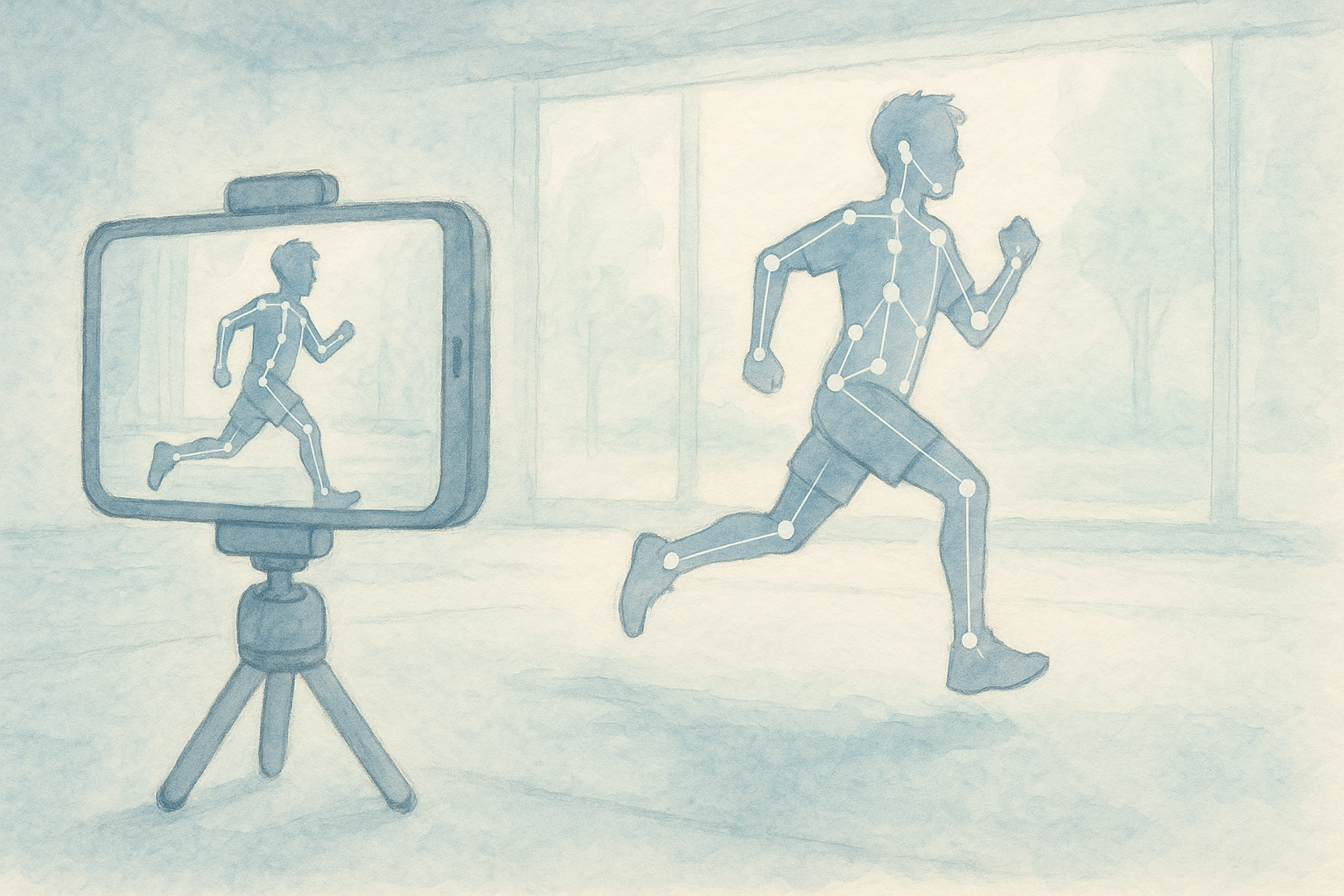
Over the last year the same small breakthrough has quietly shown up across a dozen different tools on this site: your phone's camera can now understand a human body in motion, in real time, without sending a single frame to a server. Point it at someone doing squats and it counts reps. Point it at a hitter and it counts swings. Point it at a shooter and it reads their release.
Underneath the AI Rep Counter, the AI Baseball Swing Counter, and the AI Free Throw Tracker is one idea. This is that idea, in plain English — and, just as importantly, where it stops.
The One Idea: 33 Points on a Body
Modern pose-tracking models look at a video frame and estimate the position of about 33 landmarks on a human body — shoulders, elbows, wrists, hips, knees, ankles, and so on — many times per second. Once you have those points moving through time, a huge amount becomes simple geometry.
A squat is a knee angle that closes and opens. A swing is the hands accelerating through a rotational arc. A free throw is the hands driving up into extension from a held set. None of these require the tool to "understand" baseball or basketball — they require it to watch a few joints and do trigonometry. That's why one underlying model can power tools that look completely different.
Why It All Runs on Your Device
Every one of these tools runs the pose model inside your browser — on Google's MediaPipe with the lightweight BlazePose model, executed through WebAssembly and your device's GPU. Your browser downloads the model once and then does all the work locally. The camera feed is captured with the standard getUserMedia API and handed straight to that in-browser model. There is no server in the loop and no frame ever leaves the page — which is also why these tools keep working with no connection at all once the page has loaded.
The Family, and What Each One Watches
AI Rep Counter — counts squats, push-ups, jumping jacks, and per-arm curls out loud, reading the angle at your knee or elbow.
AI Baseball Swing Counter — waits for a hitter to load and get set, then counts committed swings (warm-ups kept separate) and tags each high or low in the zone.
AI Free Throw Tracker — waits for a shooter's set, then counts the release, keeping pump fakes apart and reading elbow, arc, and leg drive.
AI People Counter — a slightly different job: it detects people in a still photo rather than tracking one body's joints, drawing a confidence-scored box on each.
The Honest Line: Read the Body, Not the Ball
Here's the part most "AI" marketing skips. A camera on a phone is excellent at tracking one well-framed body's joints and genuinely poor at tracking small, fast, or far-away objects — a ball in flight, a bat tip at 70 mph, a face in a distant crowd. So these tools are built around what a camera can actually do. The swing counter reads the hitter, not the ball; the free-throw tracker reads the shooter, not the make; none of them pretend to call balls and strikes. Drawing that line is what makes the numbers trustworthy instead of impressive-but-wrong.
A Shared Rhythm: Set, Then Action
The sports tools share a design borrowed from how athletes actually move. Fast motion alone isn't a rep — walking into frame is fast, too. So counting is gated behind a set state: the athlete has to be planted and steady, in a recognizable ready position, for about a second. Only a committed move launched from that set counts. Everything else is logged as a warm-up or a pump fake.
This one rule is why you can prop the phone down, let people wander in and out of frame, and still get a count that reflects real reps rather than every twitch the camera saw.
What Gets Saved — and What Never Does
Because the analysis is just moving points, each session can record a compact motion track: a stick figure you can replay, one rep at a time or as an average. Your video is never part of that — it stays on your device and is never uploaded, recorded, or stored. The anonymized motion data (skeleton coordinates and measurements, never images or faces) is what gets kept, both so Pro members can replay their own history and so the tools keep getting more accurate. It's a deliberately narrow thing to save: the math, not the picture.
Try One in Two Minutes
None of these need an app or an account to try. Prop a phone, pick the tool that matches what you're doing, and give it thirty seconds:
- Working out → AI Rep Counter
- At the cage → AI Baseball Swing Counter
- At the line → AI Free Throw Tracker
- Counting a room from a photo → AI People Counter
The first session tells you everything the marketing can't: whether it works in your space, with your lighting, on your body. That's the whole pitch — a coach you can prop against a wall, that never uploads the tape.